
Why I’m Paying Annual Fees on Credit Cards I Barely Use
Frank McBride • May 22, 2025
Some cards can have a place even if they don't boost your points and miles total
At any given time, I tend to use only two or three different credit cards as those few cards address the points and miles strategy I am currently following. Although I might carry only two or three cards in my wallet, there are several cards with annual membership fees that I hold onto even though I use them very little.
So, why would I keep paying the annual fees year after year for cards that add little to my points and miles totals?
American Express Delta Gold Card ($150/year)
My first choice for domestic travel is Delta and this card generates two Delta SkyMiles for every dollar spent with Delta, at supermarkets, or at restaurants. However, I put most of my supermarket and restaurant purchases on an American Express Gold card because it yields four Amex Membership Rewards (MR) points per dollar and these MR points can transfer to Delta at a 1:1 ratio. I put airline purchases on an Amex Platinum Card as that card gives you five MR points per dollar. So, by using the Gold and Platinum cards in lieu of the Delta card for those purchases, I am able to get my free Delta flights twice as fast.
However, I keep the Amex Delta Gold card for one key reason – its “TakeOff 15” feature. This lets you redeem Delta SkyMiles for 15 percent less than a SkyMiles member who does not hold one of these cards. As an example, an award flight that would otherwise cost 40,000 SkyMiles will cost 34,000 SkyMiles to a cardholder. If I am taking Delta flights that would otherwise cost 100,000 SkyMIles in total per year, that 15,000 mile reduction is worth about $150-175 which covers the annual fee.
In addition to the “TakeOff 15” feature, cardholders get their first bag checked for free and earlier boarding. The earlier boarding has ensured that I have found adequate overhead bin space on most of my Delta flights.
The Amex Delta Gold card is useful because it enhances my trips on Delta and helps me obtain award travel faster. However, it has little use outside of travel on Delta and I would cancel or downgrade this card if I did not fly Delta enough to get value from it.
American Express Platinum Card ($890/year for membership + one authorized user)
This card accounts for a very large chunk of my credit card annual fee budget. And, I make few purchases with it. The sole exception is airline spending because the Amex Platinum generates five MR points for every dollar spent. Most other purchases give you one MR point per dollar, so I use other cards for those purchases.
The key benefit of this card for Ms. Optimizer and me is access to airport lounges when traveling. The extensive network of lounges offered by this card includes Delta lounges (when flying Delta), American Express’ proprietary Centurion lounges, and the 1400+ lounges worldwide covered by the Priority Pass.
Several other benefits of the Amex Platinum card revolve around air travel. They include a $200 airline fee credit, a $179 CLEAR credit, a $200 Uber credit, and a $240 digital entertainment credit.
Despite the high cost, we feel like we are getting good value as long as we are flying with some frequency.
However, we would cancel this card if we foresaw an extended period of minimal or no air travel.
Chase World of Hyatt Card ($95/year)
A key benefit of this card is that you get one free room at your annual renewal. Hyatt has eight award levels and, while you must choose from award levels 1 to 4, it is easy to get a free room that would otherwise cost several hundred dollars. Recently, I used my annual free room benefit for a $600 room. Over the years, I have tended to get free rooms going for at least $300. This free room benefit alone pays for the annual fee.
Other benefits include occasional upgrades and priority for early check-in and late check-out.
On the occasions when we purchase Hyatt rooms or spend money at their properties (restaurant, parking, etc) we do use the card because Hyatt purchases yield four Hyatt points per dollar spent. Also, this card offers worthwhile bonuses from time to time (often the fourth quarter of the year) for achieving some spending threshold.
Citi Strata Premier ($95/year)
This travel card generates Citi ThankYou points with decent bonuses (3X) for gas, restaurants, supermarkets, hotels, and air travel. However, as I prefer to earn Chase points and Amex points, I do not use this card often.
The primary reason I happily pay for this card is that it is pairs with a Citi Double Cash card ($0 annual fee) that gives you two Citi ThankYou points per dollar spend on any purchase. The Double Cash card is essentially a two percent cash rebate card, but if you also have a Strata Premier card, you can transfer these points to airline and hotel partners. With some airline redemptions, I have been able to get three cents or more per point which triples the value of the points I earn with the Double Cash card.
Where the Travel Rewards Optimizer Fits In
When we create Travel Rewards Optimizer plans for people, we try to help clients get the most travel reward value with the least spending (including spending on credit card fees). In some cases, paradoxically, there are significant benefits to be gained with cards that you rarely use. We take these and many other factors into account to design custom and robust plans to get you to your next vacation faster.
We are ready to help you turn your routine credit card spending into the travel of your dreams.

In case you missed them, here is your "one-stop shopping" for posts from the past week. For some, recent changes with the Resy restaurant reservation platform might limit dining options when using the credit. Learn more here . Perhaps your next US domestic award flight should be booked through . . . Air France. Check out why . The Amex Platinum card might have the highest annual fee for mass marketed cards. Find out if the benefits are worth it for my household here . Hope you have a great Labor Day weekend!! We are ready to help you turn your routine credit card spending into the travel of your dreams.

A walk through one household's use of the Amex Platinum card

For some domestic flights, Air France might save transferable miles

Recent changes in the Resy reservations platform might limit use of the Amex dining credit

Changes are a mixed bag but Hyatt regulars won't be happy

Some good news in points and miles (and one warning)

A change in favor of airline passengers (for a change)

The Autograph Journey's transfer partner list grows slowly but steadily

Points and miles free up the travel budget for pilsner, paprika, and pastizzi*
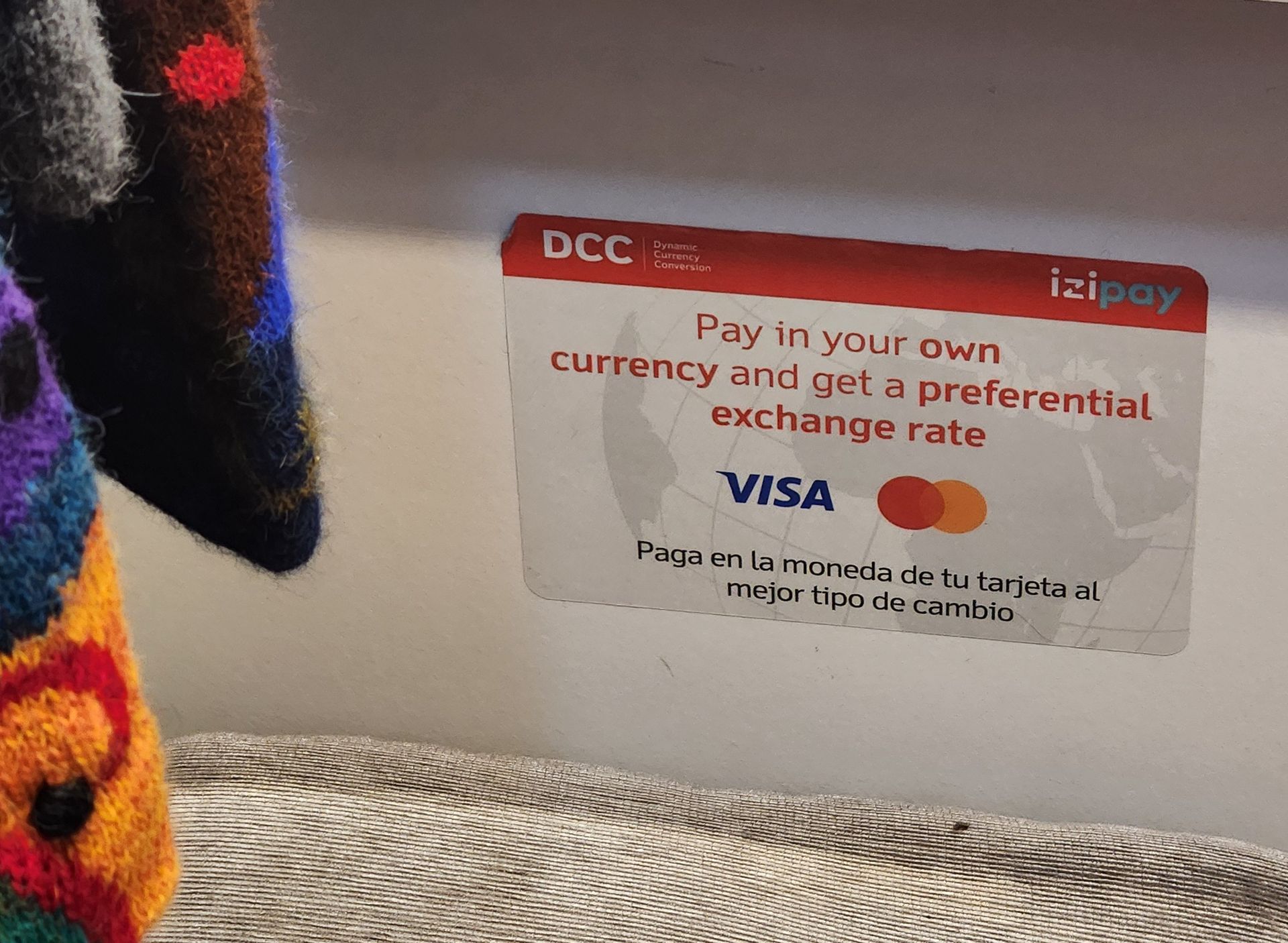
As the summer travel season approaches, this is a friendly reminder to avoid "dynamic currency conversion" (DCC) when making credit card purchases outside of your home country. DCC gives you the option of selecting a payment amount in your home currency rather than in the local currency. Typically, when presented with a credit card reader at a shop or restaurant, the touch screen will show purchase amounts in the local currency and in US dollars (for those with American credit cards) and you have the opportunity to choose. I have been seeing these “offers” for several years now and have learned, after doing a little mental math, they are almost always a bad deal for the purchaser. When presented with a credit card reader, I always choose to pay the amount shown in local currency rather than the amount shown in US dollars. During a recent trip, I was making purchases in Euros, Hungarian Forints, and Czech Korunas. From what I could tell, the option of paying in dollars inflated the cost of the purchases around an average of five percent (5%). Once, a card reader screen acknowledged that making the purchase in dollars added an eight percent (8%) fee. Even a credit card with a foreign transaction fee (which you should avoid using when traveling abroad) would have added only three percent (3%) to the tab. Currency games aside, Visa and MasterCard offer reasonable exchange rates when you choose to pay in the local currency. Upon returning home, our credit card statements showed exchange rates that were quite close to market rates. It is reasonable and fair for the credit card issuers make a fraction of a percent here and there as they are performing a service and accepting currency risk (although very briefly). But, claiming to offer a “preferential” rate to pad their bottom line is disingenuous. Because exchange rates are reasonable, using credit cards while traveling abroad is still worthwhile for a points and miles program as long as you avoid cards with foreign transaction fees. Travel oriented cards can offer 2X and 3X spending bonuses for transportation and restaurants to give you a leg up on saving money and accumulating points or miles for your next vacation.