No! Carrying Credit Card Balances Will Not Help Your Credit Scores

Frank McBride • March 20, 2024

Banks, of course, are happy if you do

I have enjoyed talking with lots of people about the Travel Rewards Optimizer over the past few months. The topics that we cover run the gamut and the topics like credit scores and the factors that have an impact on these scores come up frequently.


One comment I hear often is that you can improve your credit score by carrying balances – that is, by not paying monthly credit card statements in full. The idea is that by doing this, you are showing the credit reporting agencies that you can reliably pay debt over time. Then,  you will be rewarded with an improved FICO score.   


When I hear this, I respond with a four-letter word: NOOO!


I did a little digging and learned that a poll conducted just last year revealed that almost one-half of Americans believe that it is beneficial to carry balances. It is certainly beneficial, but not for cardholders (more on that later).


There are several factors that go into FICO scores. A key factor, which can account for one-third of your score, is your payment history. Simply paying your credit card bill on time, every time, builds a history of reliability. But, there are no bonus points for carrying a balance and pushing some of what you owe into the next month.


A second key factor, also accounting for about one-third of your score, is based on the amount you owe as a percentage of the credit available to you. Another term for this is utilization. If the total amount of credit available to you is $10,000 and you put $1,000 on a credit card in a month, your utilization is 10%. Banks do not like to see utilization going beyond 30% because this might be an indicator of financial trouble. When you pay that $1,000 in full, those purchases are removed from the utilization equation (but are, of course, replaced with new purchases for your next monthly statement). Now, let’s say you only pay $500 of your $1,000 balance. Rather than knocking $1000 out of the utilization equation, you are only removing $500. The $500 that remains is increasing your utilization rate beyond what it would otherwise be if you had paid in full. In some cases, the utilization could be high enough that you are actually lowering your credit score despite your efforts to appear responsible.


Aside from the impact or lack thereof on your credit scores, the key reason you should avoid carrying balances is that the interest rates on credit cards purchases are very high. Travel rewards cards, because of their great benefits and free travel potential, have some of the highest interest rates. There is no positive impact on your credit scores for carrying balances and you end up financing groceries, gas, cappuccinos, etc. at 20-something percent interest.


The only winner when you carry a balance is the bank that issues the credit card. But, I can assure you, they will love you for it!!


I always hope to create a Travel Rewards Optimizer for anyone I meet who wants to travel. But, if someone carries credit card balances, I warn them that the interest they will pay will probably outstrip the travel rewards they receive. My advice to them is to avoid carrying balances and avoid paying interest. If that is not possible, opt for cards with the lowest interest rates you can find. And, for those who pay their credit card statements in full, the Travel Rewards Optimizer might be for you.


We are ready to help you turn your routine credit card spending into the travel of your dreams.

By Frank McBride September 4, 2026
In case you missed them, here is your "one-stop shopping" for posts from the past week. For some, recent changes with the Resy restaurant reservation platform might limit dining options when using the credit. Learn more here . Perhaps your next US domestic award flight should be booked through . . . Air France. Check out why . The Amex Platinum card might have the highest annual fee for mass marketed cards. Find out if the benefits are worth it for my household here . Hope you have a great Labor Day weekend!! We are ready to help you turn your routine credit card spending into the travel of your dreams.

By Frank McBride September 3, 2026
A walk through one household's use of the Amex Platinum card
By Frank McBride August 28, 2026
For some domestic flights, Air France might save transferable miles
By Frank McBride August 27, 2026
Recent changes in the Resy reservations platform might limit use of the Amex dining credit
By Frank McBride June 25, 2026
Changes are a mixed bag but Hyatt regulars won't be happy
By Frank McBride June 5, 2026
Some good news in points and miles (and one warning)
By Frank McBride May 29, 2026
A change in favor of airline passengers (for a change)
By Frank McBride May 19, 2026
The Autograph Journey's transfer partner list grows slowly but steadily
By Frank McBride April 29, 2026
Points and miles free up the travel budget for pilsner, paprika, and pastizzi*
By Frank McBride April 23, 2026
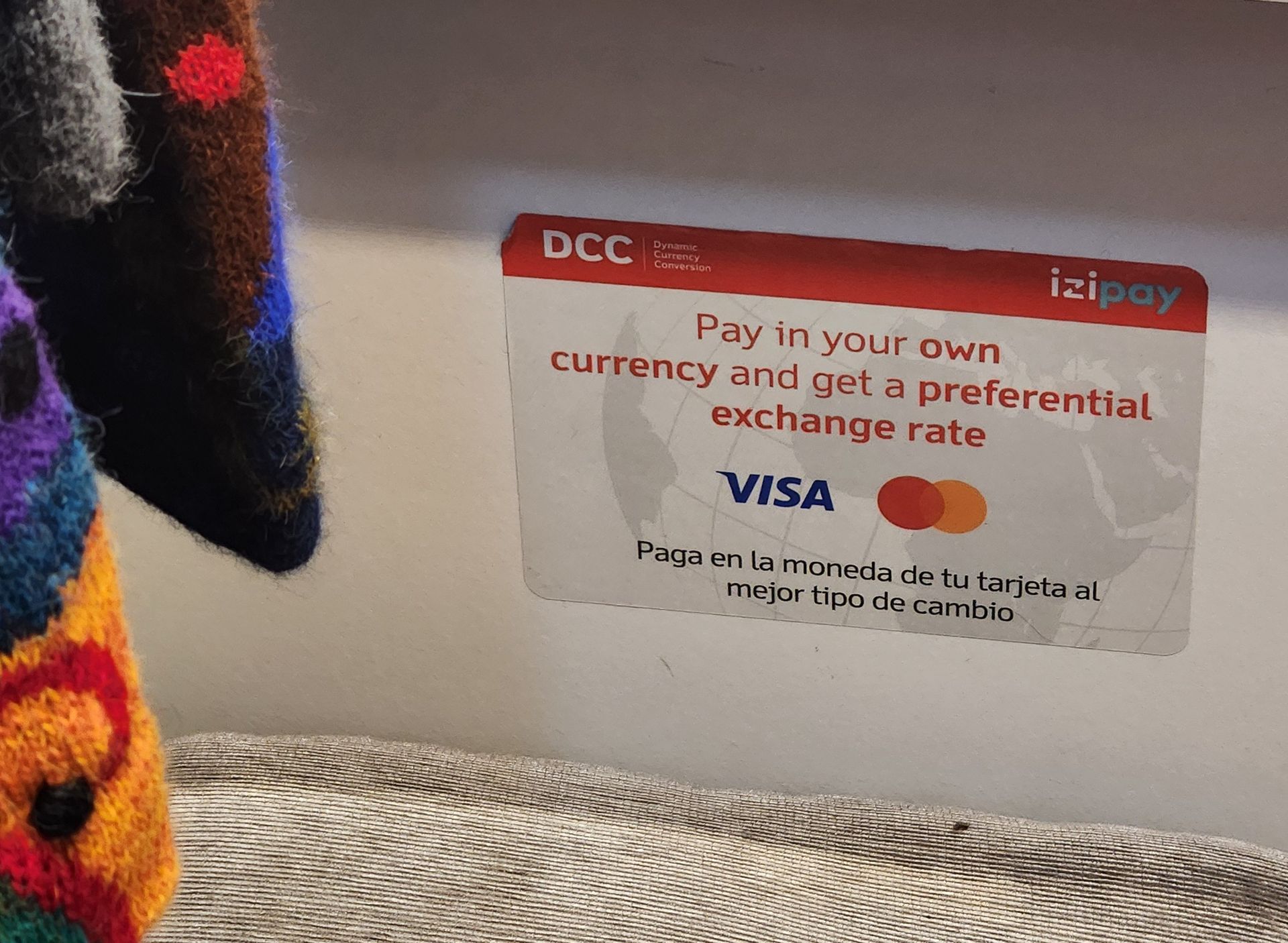
As the summer travel season approaches, this is a friendly reminder to avoid "dynamic currency conversion" (DCC) when making credit card purchases outside of your home country. DCC gives you the option of selecting a payment amount in your home currency rather than in the local currency. Typically, when presented with a credit card reader at a shop or restaurant, the touch screen will show purchase amounts in the local currency and in US dollars (for those with American credit cards) and you have the opportunity to choose. I have been seeing these “offers” for several years now and have learned, after doing a little mental math, they are almost always a bad deal for the purchaser. When presented with a credit card reader, I always choose to pay the amount shown in local currency rather than the amount shown in US dollars. During a recent trip, I was making purchases in Euros, Hungarian Forints, and Czech Korunas. From what I could tell, the option of paying in dollars inflated the cost of the purchases around an average of five percent (5%). Once, a card reader screen acknowledged that making the purchase in dollars added an eight percent (8%) fee. Even a credit card with a foreign transaction fee (which you should avoid using when traveling abroad) would have added only three percent (3%) to the tab. Currency games aside, Visa and MasterCard offer reasonable exchange rates when you choose to pay in the local currency. Upon returning home, our credit card statements showed exchange rates that were quite close to market rates. It is reasonable and fair for the credit card issuers make a fraction of a percent here and there as they are performing a service and accepting currency risk (although very briefly). But, claiming to offer a “preferential” rate to pad their bottom line is disingenuous. Because exchange rates are reasonable, using credit cards while traveling abroad is still worthwhile for a points and miles program as long as you avoid cards with foreign transaction fees. Travel oriented cards can offer 2X and 3X spending bonuses for transportation and restaurants to give you a leg up on saving money and accumulating points or miles for your next vacation.